If you are specifying or operating a utility-scale PV plant in a dusty region, you already know the question. The number behind it, however, is rarely given out honestly: dust on module glass is not a cosmetic issue. In sandy, Gobi, desert, and semi-arid sites — the same regions that deliver 3,500+ sunshine hours a year — soiling can take 15% to 30% of annual generation before you even notice it.
Run that back through a 1 GW plant. At an annual yield of roughly 2,300 kWh/kWp, a 15% soiling loss means 345 GWh gone every year; at 30%, nearly 700 GWh. That is not a cleaning-budget problem. It is a project-level return problem.
Dust does not settle evenly everywhere. Particle analysis from sites in Alice Springs (Australia), Pune (India), and Dunhuang (China) shows that the vast majority of dust landing on module surfaces sits in the 20–300 μm range. Particles below 20 μm stay suspended at low wind speeds and rarely settle; particles above 300 μm move by surface creep and rarely reach panel height. The 20–300 μm band arrives by saltation — bounced along the ground by wind — and sticks to the glass through electrostatic and capillary forces.
This is why soiling is worst in exactly the best-sun regions: high irradiation, low rainfall, strong wind, and little vegetation. Rain — the module's natural cleaner — rarely arrives to wash panels clean.
When buyers hear "anti-soiling coating," they usually imagine a water-beading, lotus-leaf surface. That is the hydrophobic route. It works by making water contract into droplets that roll off and carry dust with them.
There is a second, less talked-about route: the hydrophilic coating. Instead of beading water, it spreads it into a thin, continuous film. When rain or rinse water hits the panel, the film slides off as a sheet — peeling dust away in one pass rather than waiting for droplets to form.
You can tell which route a product is from by its water contact angle:
· Hydrophobic coatings typically sit above 90°.
· Hydrophilic coatings sit below 90°, often around 20–40°.
A contact angle around 30° is not a weakness. It is the signature of the hydrophilic, film-forming route — and for arid-region plants that get only occasional light rain, it often outperforms hydrophobic coatings because light drizzle is enough to trigger a clean, whereas hydrophobic surfaces need larger droplets to roll.
When a supplier hands you an anti-soiling glass test report, do not stop at the transmittance number. These are the four rows that tell you whether the coating will survive 25 years:
· Solar-weighted transmittance (380–1100 nm). With AR coating, expect ≥93.5%. If the number lands below that, the anti-soiling layer is costing you watts.
· Pencil hardness. A soft coating scratches off in the first robotic cleaning pass. Look for 3H or harder.
· Cross-hatch adhesion. Must be 0 grade — no square of coating lifts off the glass.
· Post-damp-heat / post-freeze-thaw / post-PCT transmittance decay. Each accelerated aging test should leave transmittance decay under 1%. If decay runs at 2–3%, the coating is degrading inside the accelerated chamber and will not hold 25 years in the field.
A 2026 third-party report from the National Solar PV Products Quality Inspection Center in Wuxi on a 3.2 mm single-layer anti-soiling coated glass from Xinfuxing shows exactly this profile: solar transmittance 93.70% (vs. ≥93.5% required), pencil hardness 3H, cross-hatch 0 grade, contact angle 29.7°–33.6°, and post-aging transmittance decay of 0.32%–0.74% across damp-freeze, pressure-cooker, sand-dust, and stain-resistance cycles — all comfortably under the 1% threshold.
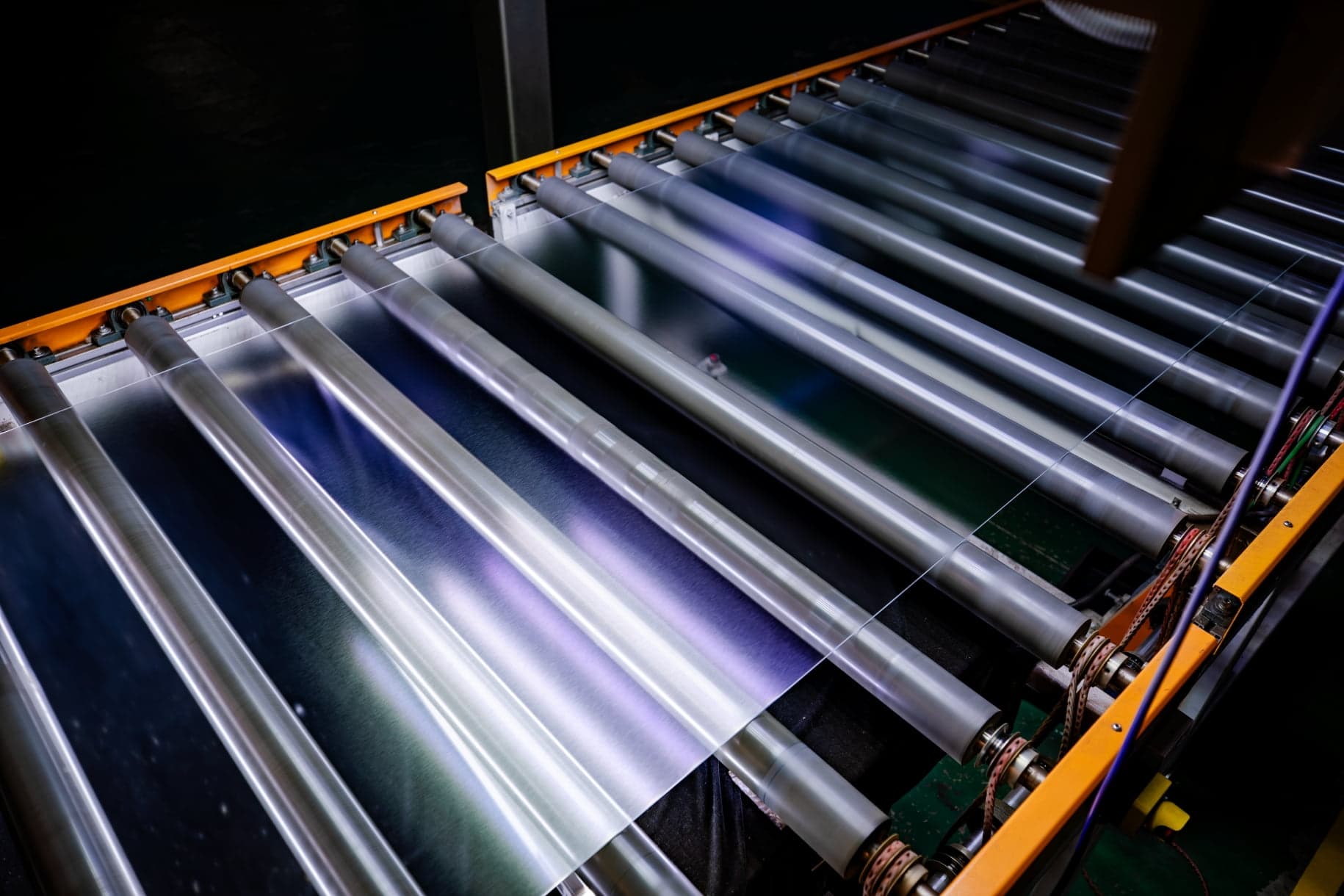
For comparison, in a dust oscillation test per ASTM F735 using Arizona Test Dust, an anti-soiling coated surface showed almost no dust accumulation and minimal transmittance loss, while a standard AR-coated surface lost roughly 2% and uncoated glass lost roughly 4%.
It is not the right choice for every plant. Use this quick filter:
|
Scenario |
Anti-soiling glass worth it? |
|
Utility plant in desert / Gobi / semi-arid zone, <100 mm annual rainfall |
Yes — soiling loss is 15–30%, cleaning water and labor are expensive |
|
Floating PV on reservoirs |
Conditional — dust load is lower, but bird droppings and algae make self-cleaning useful |
|
C&I rooftop in industrial zone |
Often yes — oil-laden dust sticks hard and manual cleaning is a safety issue |
|
Rooftop PV in wet, rainy climate |
No — rain already keeps panels clean; the coating cost will not pay back |
|
Mountain / hill terrain where cleaning vehicles cannot reach |
Yes — every manual cleaning visit is a logistical cost and safety risk |
Xinfuxing Glass manufactures anti-soiling coated ultra-clear patterned PV glass, with third-party test report covering transmittance, hardness, adhesion, damp-freeze, PCT, sand-dust, and stain-resistance performance. If you are specifying glass for a desert, Gobi, industrial-rooftop, or difficult-terrain project, contact us for the full report and current spec sheet.
WhatsApp : +8615059190820
WhatsApp : +8618850736588
Email : elva@xfxglass.com
Email : business@xfxglass.com
Tel : +8615059190820
Tel : +8618850736588