If you operate or insure a solar plant in a hail-prone region — Southern Europe, the U.S. Midwest, parts of India, or Northern China — you have probably seen the post-storm photos: rows and rows of cracked panels, every one of them certified. How can a panel that passed every type test in the lab end up shattered in the field?
The short answer is that the industry's hail test is a baseline, not a guarantee. Understanding what it actually covers — and, just as importantly, what it does not — is the difference between a spec sheet that looks good and a plant that survives a real storm.
The qualification test used in IEC 61215 (and its UL 61730 equivalent) fires a 227 g steel ball at the module from a drop height of 1.0 meter. At impact, the ball carries roughly the same kinetic energy as a hailstorm event that designers treat as the design reference — not the worst storm ever recorded, but the storm a plant is expected to survive without catastrophic breakage.
The test deliberately uses a steel ball, not real hail, because steel is rigid and repeatable. Real hail is softer, often partially melted, and comes in shapes that are not perfect spheres. This is the first thing to understand: the standard test is a conservative proxy, not a simulation of an actual storm.
Passing the 227 g / 1.0 m test means:
· The cover glass did not crack through after a single impact at the reference energy.
· The module still met electrical and insulation requirements afterward.
· The design (glass thickness, temper, framing) is structurally sound for the reference event.
It does not mean:
· The panel will survive a larger, faster, or multi-impact storm. Real hailstorms rarely deliver one perfect sphere; they deliver a spray of mixed sizes, sometimes repeatedly.
· A 35 mm+ hailstone moving at terminal velocity in a supercell storm. That energy is well above the standard test.
· Long-term damage from repeated smaller impacts that leave microcracks the naked eye cannot see.
This gap between "passed the type test" and "survived the storm" is why insurance underwriters in hail-heavy regions now ask for higher glass specs as a condition of coverage.
For reference, a 2026 third-party report (No. 2026DACS20061, National Center of Inspection on Solar Photovoltaic Products Quality, Wuxi) on Xinfuxing's 3.2mm double-sided AR fully tempered glass went one step beyond the steel-ball baseline: instead of a rigid ball, it fired 35mm ice balls at 27.2 m/s across 11 impact points on the coated surface, and all three samples remained unbroken. The same report covered 18 other reliability items — damp-heat (85°C/85%RH for 1000h), UV irradiation (120 kWh/m²), thermal cycling (-40°C to 85°C, 200 cycles), neutral salt spray (96h), acid and ammonia immersion, PCT pressure cooker (121°C, 48h), sand and dust, abrasion, and 2400Pa static pressure — with post-test transmittance decay staying between 0.19% and 0.75%, well inside the 1% threshold.
When you compare glass options for a hail-prone site, these are the rows that matter:
· Glass thickness. Heavier glass absorbs impact energy better. The industry default for single-glass modules is 3.2 mm fully tempered; upgrading means thicker or laminated.
· Temper type. Fully tempered glass breaks into small, blunt cuboids — it fails safely. Semi-tempered (used on 2.0 mm and 1.6 mm thin glass for bifacial modules) breaks into larger pieces, which is why thin-glass bifacial plants in high-hail regions often add a laminated or thicker back-sheet strategy.
· Laminated cover options. If hail risk is extreme, some projects specify laminated cover glass (two plies with a PVB or EVA interlayer) so that even if the outer ply cracks, it stays in place instead of falling into the field.
· Frame and clamp design. Glass does not fail in isolation; poor clamping concentrates stress at the edges. A spec sheet that only lists glass properties without frame compatibility is incomplete.
Ask yourself three questions before upgrading beyond the standard 3.2 mm fully tempered cover:
· What is the 50-year hail return in your site? Meteorological services in most countries publish hail frequency maps. If your site sits in a high-return band, the standard test is not your design basis.
· What does your insurance underwriter require? Some policies now mandate thicker or laminated glass in hail zones. If so, the upgrade is not optional.
· What is the cost of downtime versus the cost of glass? For a utility plant, one day of lost generation from cracked panels often exceeds the incremental cost of a higher-spec glass over a 25-year contract.
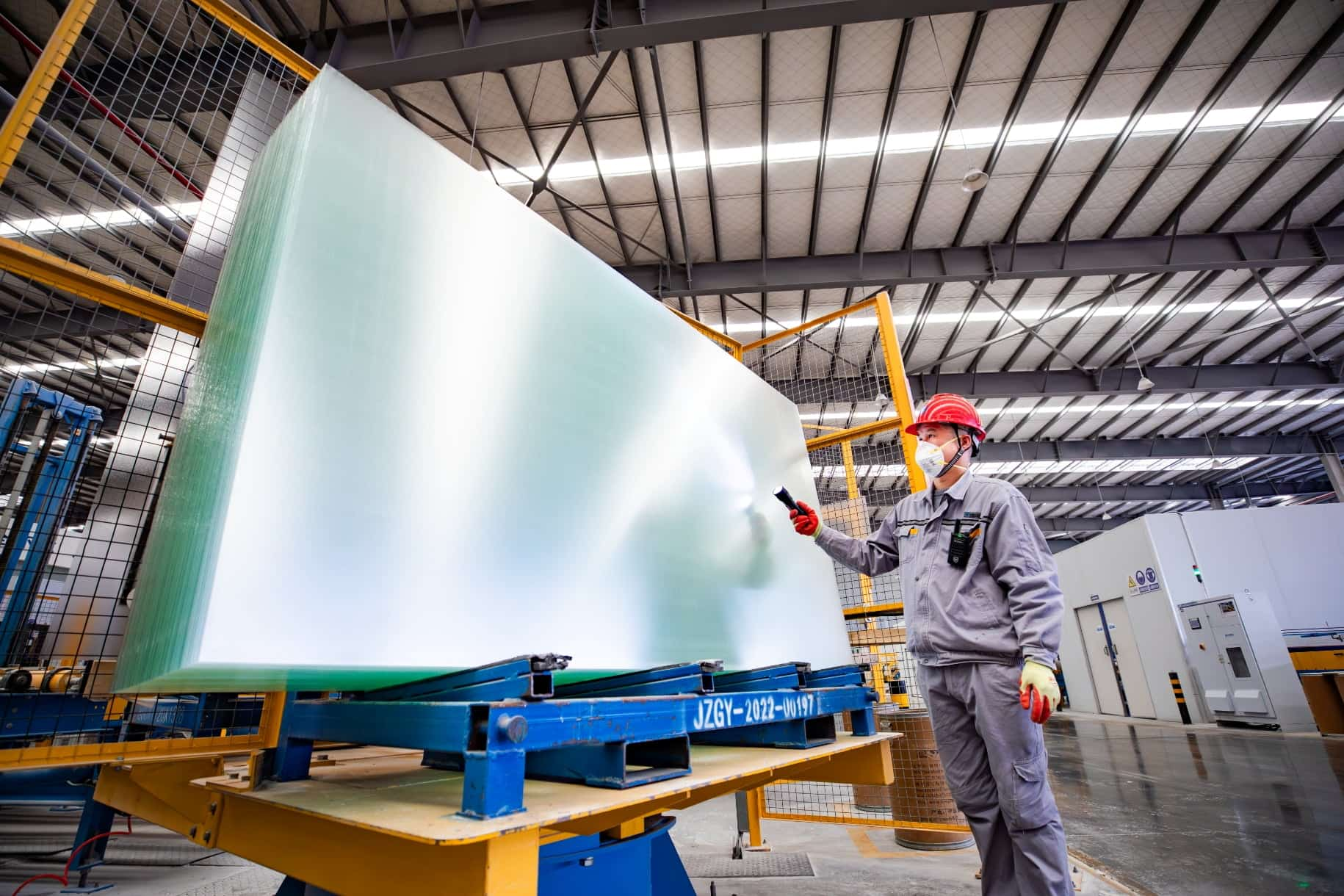
Xinfuxing Glass manufactures the full PV cover-glass line — 1.6 mm / 2.0 mm semi-tempered and 2.5 mm / 3.2 mm fully tempered ultra-clear patterned glass. The 3.2 mm double-sided AR fully tempered grade is third-party certified (Report No. 2026DACS20061) to survive 35 mm ice balls fired at 27.2 m/s across 11 impact points, alongside 18 other reliability tests with under 1% transmittance decay. Optional double-sided AR and anti-soiling coating are available. If you are specifying glass for a hail-prone utility, C&I, or FPVS project, contact us for the full test report and current spec sheet.
WhatsApp : +8615059190820
WhatsApp : +8618850736588
Email : elva@xfxglass.com
Email : business@xfxglass.com
Tel : +8615059190820
Tel : +8618850736588