For the past decade, the cover glass on the front side of PV modules has almost by default been 3.2mm. Today, however, a change is underway that many people still underestimate: in China, more and more newly installed bifacial modules are now using 2.0mm glass on both the front sheet and the back sheet. Glass is getting thinner — and quietly rewriting the material-sourcing logic of the photovoltaic supply chain.
For module manufacturers and procurement teams who are selecting glass or comparing suppliers, understanding what this round of "thinning" means is one of the most valuable decisions they can make right now.
1.Bifacial modules go mainstream, and 2.0mm moves up accordingly
The spread of bifacial cells (TOPCon, HJT, BC) has made "generating power from the back side too" a reality. To capture back-side light, a module must adopt a bifacial (double-glass) structure — one sheet of glass on the front and one sheet of glass on the back.
Double-glass encapsulation directly amplifies the demand to "cut weight and cut thickness":
· If a bifacial module kept a 3.2mm cover sheet, it would be noticeably heavier, raising installation, transportation, and racking costs;
So 2.0mm has gradually become the standard specification for bifacial modules — a 2.0mm front sheet and a 2.0mm back sheet — making the whole module lighter and thinner while still meeting light-transmittance and mechanical performance requirements.
This is not a forecast from any single manufacturer; it is already a reality. According to statistics from the China Photovoltaic Industry Association (CPIA, on the China market basis), the market share of 2.0mm front cover glass reached 65.5% in 2023, well ahead of the 32.5% held by 3.2mm — just one year earlier, the split had been 39.7% versus 59.3%. The market is voting with its orders: thinner, lighter, and more transparent glass creates value, not merely a lower price.
2. Why is thinner worth it? Three real reasons
1) Lighter = lower logistics and racking costs. Comparing 2.0mm ultra-clear glass with 3.2mm, glass weight is reduced by roughly 35%. Lighter modules mean containers can be packed more fully, racking loads are lighter, and rooftop load-bearing requirements are more relaxed. For module makers exporting overseas, logistics cost is real profit.
2) Thinner = more light transmission. The thinner the glass, the less light is absorbed and reflected as it passes through: the thinning itself delivers roughly 2.5 percentage points of transmittance gain, and when double-sided AR coating is applied on an ultra-clear low-iron substrate, transmittance can be raised by a further ~2 percentage points (per Xinfuxing Glass). 2.0mm glass lets more effective light reach the cell — the gain comes from the glass rather than the cell, making it one of the most cost-effective efficiency improvements available.
3) A better match for "bifacial generation". The combination of double-glass encapsulation and bifacial cells is, in itself, the core reason bifacial modules are being adopted at scale. Thinner glass makes this combination more feasible and more economical.
3. The enemy of thinner: brittleness and stress
Any article that only touts the benefits of "thinner" and says nothing about the trade-offs deserves scrutiny. The reality is:
· The thinner the glass, the harder it is to control stress distribution during physical tempering, and the higher the risk of breakage;
· Thin glass is more prone to edge chipping and damage during cutting, handling, and transport;
· If any step in the chain slips out of control, the cost of falling yield rates is passed directly on to the buyer.
So the real dividing line for "2.0mm" is not whether it can be made, but whether it can be made consistently on a mass production line. When selecting a thin-glass supplier, the most important thing to examine is not the thickness figure itself, but the process-control capability behind it.
4. Xinfuxing Glass’s 2.0mm solution
When we make thin glass, we are not chasing "the thinnest" — we make 2.0mm that is "stable, deliverable, and reassuring for your module yield."
2.0mm ultra-clear patterned double-sided AR-coated glass (front sheet). Built on a low-iron ultra-clear substrate with double-sided AR coating, it reduces reflection and boosts light transmission while also providing dust resistance, self-cleaning, and weather durability. Light, thin, and strong, it suits the demanding outdoor operating conditions of bifacial modules.
High-durability bifacial back-sheet glass (2.5/3.2mm fully tempered, high-reflectivity enamel coating). UV-resistant, hail-resistant, and resistant to temperature differentials, it is optimized for extreme climates such as the harsh winters of Northern Europe and the intense sun of Southern Europe. The back sheet can also be customized to a 2.0mm same-thickness solution for a full 2.0mm + 2.0mm all-thin bifacial structure, so the back glass is as light and as durable as the front sheet.
Full thickness system, compatible with mainstream cells. Standard thicknesses cover 1.6/2.0/2.5/3.2mm — bifacial modules commonly use 1.6/2.0/2.5mm, while single-glass modules commonly use 3.2mm. It is compatible with mainstream cells including TOPCon, HJT, PERC, and bifacial, and matches both single-glass and double-glass production lines.
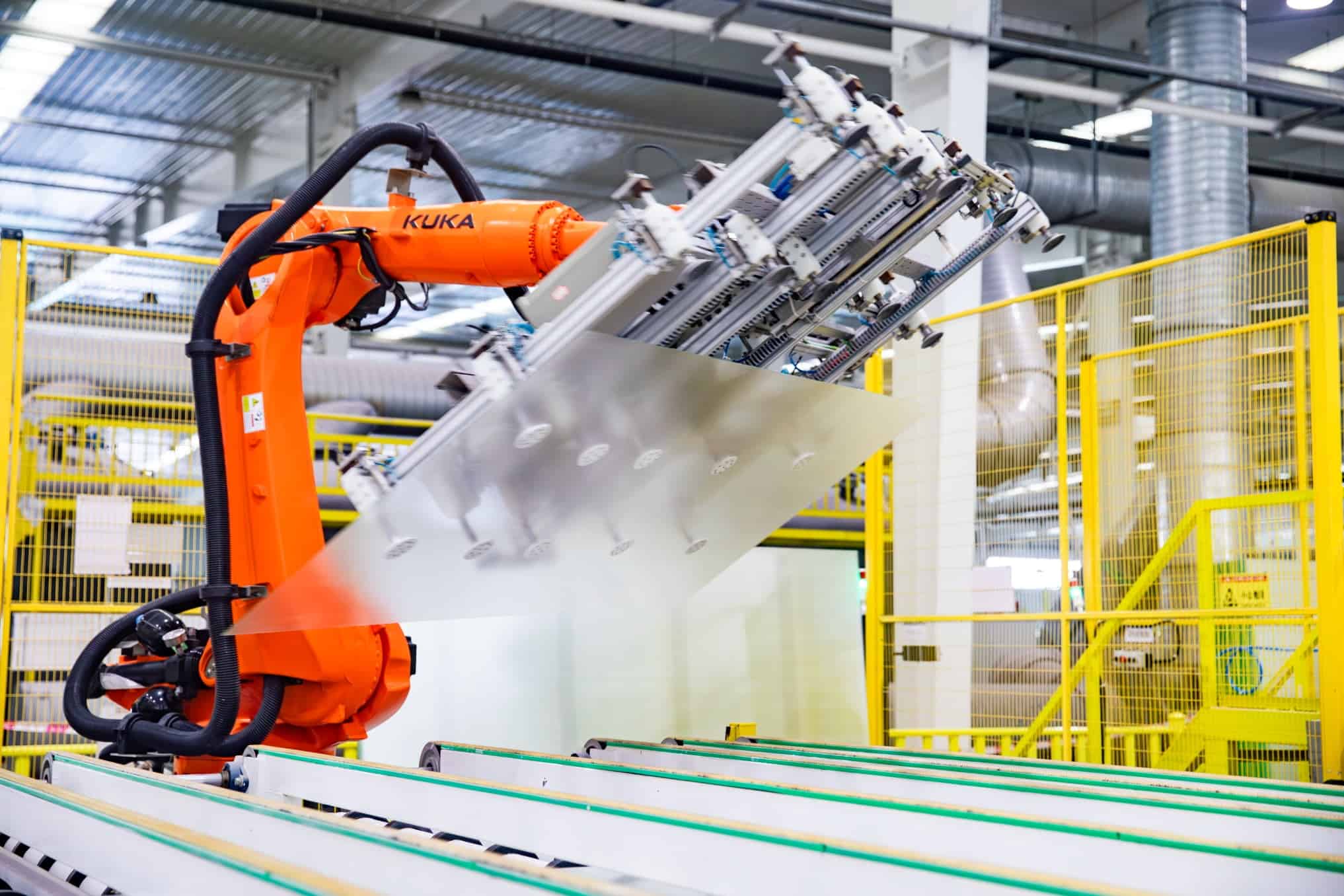
Stability is the real threshold for thin glass. The yield of thin glass is determined not by the thickness figure but by process consistency. Backed by the Beihai base, which has been rated an "advanced smart factory" at the autonomous-region level, Xinfuxing uses the process control of an intelligent production line to safeguard the quality of every sheet of 2.0mm glass — which is also why we are confident in bringing 1.6mm and 2.0mm lightweight glass to overseas customers at The Smarter E Europe in Munich.
Closing: Why choose Xinfuxing?
2.0mm is a trend, but not the end point — the path toward 1.6mm and even thinner is already unfolding. For procurement teams, the real question has never been "should we go thinner," but "who can make thin glass consistently on a mass production line."
Choosing thin glass means choosing a supplier that can truly "hold the thinness." Xinfuxing gives you four reasons:
· Truly mass-produced, truly delivered 2.0mm — At The Smarter E Europe in Munich from June 23 to 25, 2026, we exhibited 1.6mm and 2.0mm lightweight glass on site;
· One-stop supply of front and back sheets — Standard thicknesses cover 1.6/2.0/2.5/3.2mm, fully compatible with both single-glass and double-glass modules; one supplier solves all your glass needs and reduces interface risk;
· A smart factory underpinning process consistency — The Beihai base, rated an "advanced smart factory" at the autonomous-region level in 2025 (second level of China’s smart factory gradient), uses a digitalized production line to safeguard the yield of every sheet of 2.0mm glass;
· Service that understands overseas standards — From the world debut at The Smarter E Europe in Munich to going global, we understand module makers’ specifications, certifications, and delivery rhythm.
Choosing Xinfuxing is not just choosing a thinner sheet of glass — it is choosing a partner whose "thinness" is stable and whose delivery you can rely on, for your bifacial modules.
If you are selecting front-sheet or back-sheet glass for bifacial modules, or would like to verify the real performance of our 2.0mm in terms of yield and transport, send us your specifications — our engineering team will provide process recommendations and sample solutions.
WhatsApp : +8615059190820
WhatsApp : +8618850736588
Email : elva@xfxglass.com
Email : business@xfxglass.com
Tel : +8615059190820
Tel : +8618850736588